

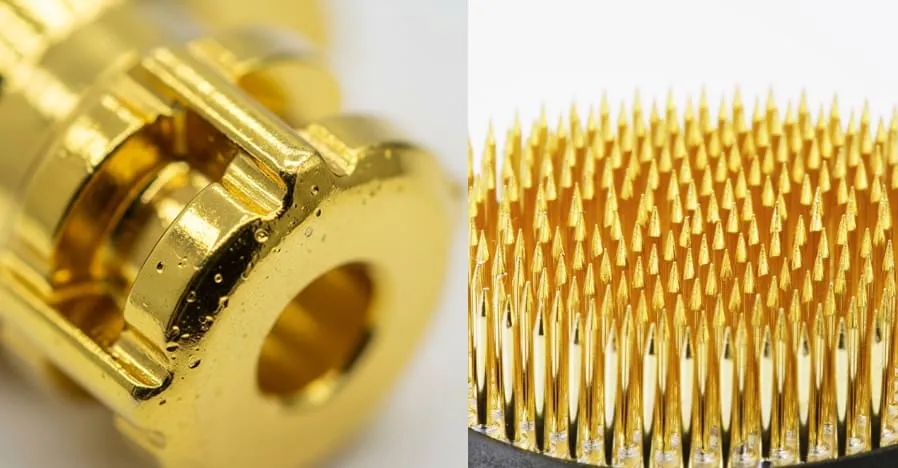
Gold plating for hybrid connectors
SM Finishes plates gold on hybrid connector contacts to ASTM B488 and, where the print calls it, MIL G 45204 (including cobalt-hardened alloy gold). Thickness on our published range is 0.05 µm to 10 µm. Process control is ISO 9001:2015 and AS9100:2015 from Machohalli, Bengaluru — founded October 2019, led by William Anthony Raj J (27 years in surface engineering).
Gold is specified when low contact resistance, corrosion immunity and mating cycles all matter. Undercoats (typically nickel, often over copper) are controlled so the gold does not pore through to base metal. That is the difference between a decorative flash and a finish Japanese and Taiwanese OEMs will PPAP. Lead time is quoted from the drawing, lot size and whether first-article or PPAP is required — we do not publish a one-size catalogue day-count.
Why Our Gold Plating Stands Out
Combining precision, purity, and performance, our gold plating delivers unmatched quality for every application.
- Unmatched Purity
- Superior Adhesion
- Custom Thickness
- Corrosion Resistance
- Precision for Every Industry
- Premium Grade

Our gold plating process is designed to deliver exceptional quality, combining advanced techniques, strict quality control, and skilled craftsmanship to ensure every component meets the highest standards of durability, conductivity, and visual perfection.
Precision & Craftsmanship
Every gold-plated component we deliver reflects our commitment to detail, combining advanced techniques with skilled workmanship to achieve flawless results every time
Applications
Our gold plating services cater to a wide range of industries, delivering both functional and decorative benefits. Whether you need enhanced electrical conductivity, corrosion resistance, or a premium visual finish.
Gold plating process at SM Finishes
Contacts arrive as copper alloy, brass or nickel-prepared steel. We clean, activate and plate the stack on the print: copper where levelling is needed, electrolytic nickel as the diffusion barrier, then gold to the specified purity and thickness. Rack plating holds each contact so edges and functional faces stay in spec. Barrel is used for bulk small hardware when the print allows tumbling. Selective and reel-to-reel spot gold keep gold only on the contact zone — see our reel-to-reel page for strip.
Thickness is verified in-house on Fischer XRF (XDV-SDD) with RoHS / WEEE / ELV heads available. Travellers and thickness records can travel with the lot. Automotive programmes can add PPAP; we have named audit experience with Suzuki, Maruti, Schneider and Kostal — documented on our case-studies page, not invented reject-rate claims. OEM programmes include SpaceX and Israel Defence.
Applications in aerospace, defence, EV and industrial I/O
Aerospace and defence hybrid connectors typically specify gold over nickel on signal contacts because the oxide-free surface stays stable at low contact force. EV high-speed data and industrial I/O use gold when mating cycles and humidity would tarnish silver or thicken tin oxides. Decorative jewellery gold is a different duty cycle; we will say so if a print looks decorative rather than connector-grade.
Shells and hardware around those contacts are often passivated stainless or conversion-coated aluminium — quote the full assembly so masking is planned once. Export programmes to Japan and Taiwan should send gold purity, nickel barrier, inspection method and annual volume with the first RFQ.
Barrel vs rack gold plating — which do you need?
Barrel plating tumbles bulk small parts: lower cost per piece, more thickness scatter, not ideal for precision hybrid contacts. Rack plating fixtures each part so gold thickness on the functional face is held — that is the usual choice for connector contacts. Reel-to-reel is continuous-strip selective gold for high-volume stamped terminals. Many platforms prototype on rack and transfer to reel-to-reel at SOP; we can support both so the metallurgy stays consistent.
Related finishes: silver when current density dominates — see also gold vs silver plating for connectors — bright tin when the joint will be soldered, reel-to-reel spot gold, and the defence / AS9100 page.
Questions? You’re covered
We’ve gathered answers to the most common questions to help you understand our services, processes, and quality standards with ease.


